How much protein do you need to lose weight?
Most people losing weight do well on about 0.7 grams of protein per pound of goal weight. Here is how to work out your own number, what it looks like in real meals, and how to hit it without living on shakes.
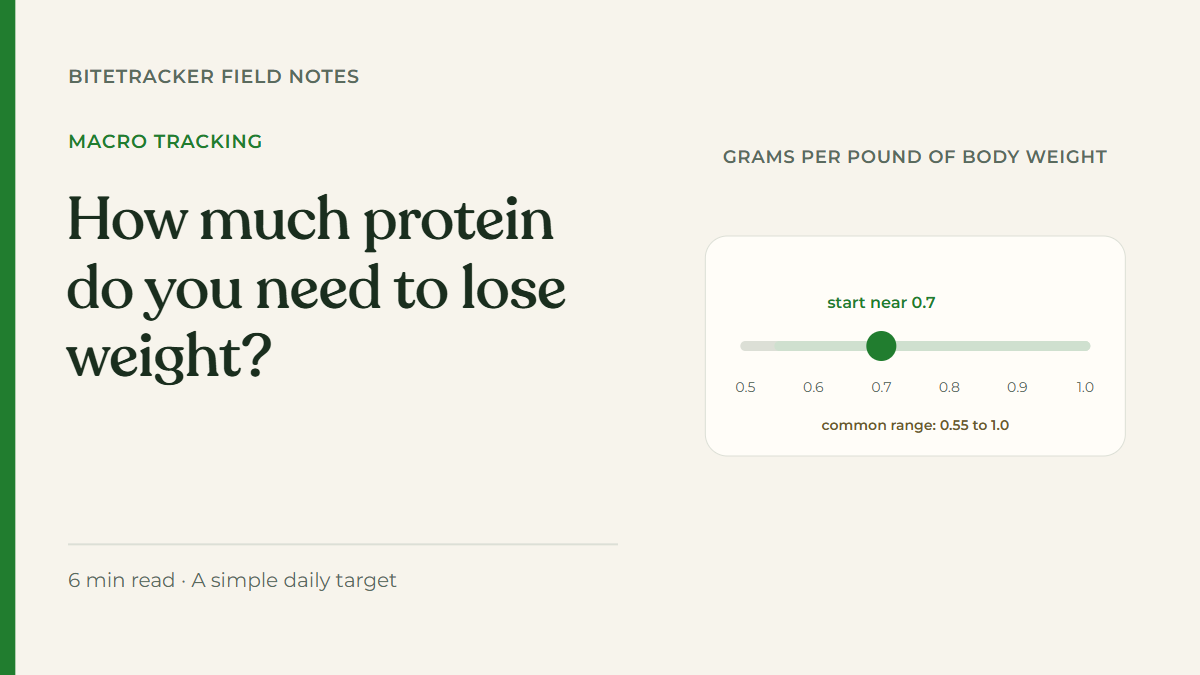
- For weight loss, a practical range is about 0.55 to 1 gram of protein per pound of body weight (1.2 to 2.2 grams per kilogram). Most people do well near 0.7 grams per pound.
- If you have a lot of weight to lose, calculate from your goal weight rather than your current weight.
- Aim for 20 to 40 grams at each main meal. It is far easier than trying to catch up at dinner.
Work out your protein target in three steps
The best protein target is high enough to make a difference and low enough that you reach it most days.
Pick a point in the range
Start near 0.7 grams per pound (about 1.6 grams per kilogram) if you are unsure. It is enough to support fullness and muscle for most people without making every meal about protein. If you lift weights and are in a deeper deficit, move toward the top of the range. If 0.7 feels impossible, start at 0.55 and build up over a few weeks.
Choose the right body weight
For someone with a lot of weight to lose, a target based on current weight can produce a number that is hard to eat and not needed. Using your goal weight, or a weight halfway between current and goal, gives a target that is still generous and much easier to reach. Someone at 240 pounds aiming for 180 might use 180 × 0.7, or about 125 grams a day.
Split it across your meals
Divide the target by the meals you actually eat. A 125-gram target across three meals and a snack is roughly 35, 35, 35 and 20. Seeing it per meal makes it concrete: a breakfast with 10 grams of protein is where most days fall short, and fixing it is usually one swap.
How much protein do you need to lose weight?
The official Recommended Dietary Allowance for adults is 0.8 grams of protein per kilogram of body weight, about 0.36 grams per pound. That number is a minimum to avoid deficiency in a typical, weight-stable adult. It was not designed for someone eating less than they burn and trying to keep their muscle.
Research on people who exercise points higher. The International Society of Sports Nutrition concludes that 1.4 to 2.0 grams per kilogram a day is enough for most exercising people, and that resistance-trained people in a calorie deficit may benefit from even more. For everyday weight loss, a practical range is about 1.2 to 2.2 grams per kilogram, or 0.55 to 1 gram per pound.
- 150-pound goal weight: about 80 to 150 grams a day, with 105 grams (0.7 g/lb) as a sensible start.
- 180-pound goal weight: about 100 to 180 grams a day, starting near 125 grams.
- 220-pound goal weight: about 120 to 220 grams a day, starting near 155 grams.
Why protein matters more in a calorie deficit
When you eat less than you burn, your body draws on its stores, and not all of that comes from fat. Enough protein, together with some resistance training, helps you keep more muscle while the scale goes down. That matters for strength, for how you feel, and for how your body looks at the end of the diet.
Protein is also the most filling of the three macronutrients for most people. Meals built around it tend to keep you satisfied for longer, which makes a calorie target for weight loss feel less like a restriction and more like a plan.
What 30 grams of protein looks like
Numbers are easier to hit once you can picture them on a plate. These are rough values for common portions; check the label or your tracking app for exact figures.
- A palm-sized portion (3 to 4 ounces cooked) of chicken, fish or lean meat: 25 to 35 grams.
- Three large eggs: about 18 grams.
- A single-serve cup of plain Greek yogurt: about 15 to 20 grams.
- A cup of cottage cheese: about 24 grams.
- A cup of cooked lentils or beans: about 15 to 18 grams.
- Half a block of extra-firm tofu, about 7 ounces: roughly 20 to 25 grams.
- A can of tuna, drained: about 20 to 25 grams.
How to spread protein across the day
Dinner usually takes care of itself. Breakfast and snacks are where protein disappears: toast, cereal, fruit and crackers are fine foods, but they carry little protein. Swapping one of them for eggs, yogurt or cottage cheese is often enough to close the gap.
Aim for 20 to 40 grams at each main meal, spaced a few hours apart. This matches what sports nutrition research suggests for muscle, and it is simply easier: three meals of 35 grams feel normal, while a 90-gram dinner does not.
If budget is a concern, lean on eggs, canned fish, lentils, tofu and dairy. Our guide to cheap high protein meals ranks the staples that cost least per gram, and the BiteTracker high-protein recipe collection lists protein per serving for every dish.
Do you need protein shakes?
No. Shakes and bars are convenient when you are short on time, but whole foods can cover a weight loss target for almost everyone, and whole-food meals tend to be more satisfying. A shake is useful as a bridge, for example after a morning workout, not as the foundation of the plan.
If you do use one, log it like any other food. Some ready-to-drink shakes and bars carry more sugar and calories than their labels suggest at a glance, so read the nutrition label or scan the barcode.
Is a high-protein diet safe?
For healthy adults, intakes in the ranges above are widely used in research and sports nutrition. If you have kidney disease, a history of kidney problems, or another condition that affects how you process protein, talk to your doctor or a registered dietitian before raising your intake. The same applies during pregnancy.
Track the weekly average, not the perfect day
Like calories, protein is best judged over a week. Some days you will be over, some under. In BiteTracker, set your protein goal once and let the macro bar fill as you log each meal. If the weekly average sits below your target, fix the weakest meal rather than forcing a huge portion at dinner. For portion estimates without weighing, see how to track macros without a food scale.
Frequently asked questions
How many grams of protein should I eat a day to lose weight?
A practical range is 0.55 to 1 gram per pound of goal weight (1.2 to 2.2 grams per kilogram). For most people, about 0.7 grams per pound is a good starting point: roughly 105 grams a day at a 150-pound goal weight or 125 grams at 180 pounds.
Should I calculate protein from my current weight or goal weight?
If you have a lot of weight to lose, use your goal weight, or a point halfway between current and goal. It keeps the target generous without making it unrealistic.
Can I eat too much protein?
Healthy adults tolerate the ranges in this article well. Going far above them rarely adds benefit and crowds out other foods. If you have kidney disease or another medical condition, ask your doctor or a dietitian for a personal target.
Does protein help you lose weight on its own?
Protein does not cause weight loss by itself; a calorie deficit does. What protein does is make the deficit easier to stick to, by keeping meals filling, and help you keep muscle while you lose fat.
Track protein next to calories in BiteTracker
Set a daily protein goal alongside your calorie target and the macro bars show how each meal moves you toward it.
Sources
- International Society of Sports Nutrition Position Stand: protein and exercise, Journal of the International Society of Sports Nutrition, 2017
- Protein, The Nutrition Source, Harvard T.H. Chan School of Public Health
- FoodData Central, U.S. Department of Agriculture
This article is general information, not medical advice. If you have a health condition, talk to your doctor or a registered dietitian before changing how you eat.