How to track calories on weekends without undoing your week
Five careful days and two untracked ones can add up to no deficit at all. Tracking calories on weekends gets easier when you budget by the week instead of the day, so you have room to enjoy Saturday without losing the progress.
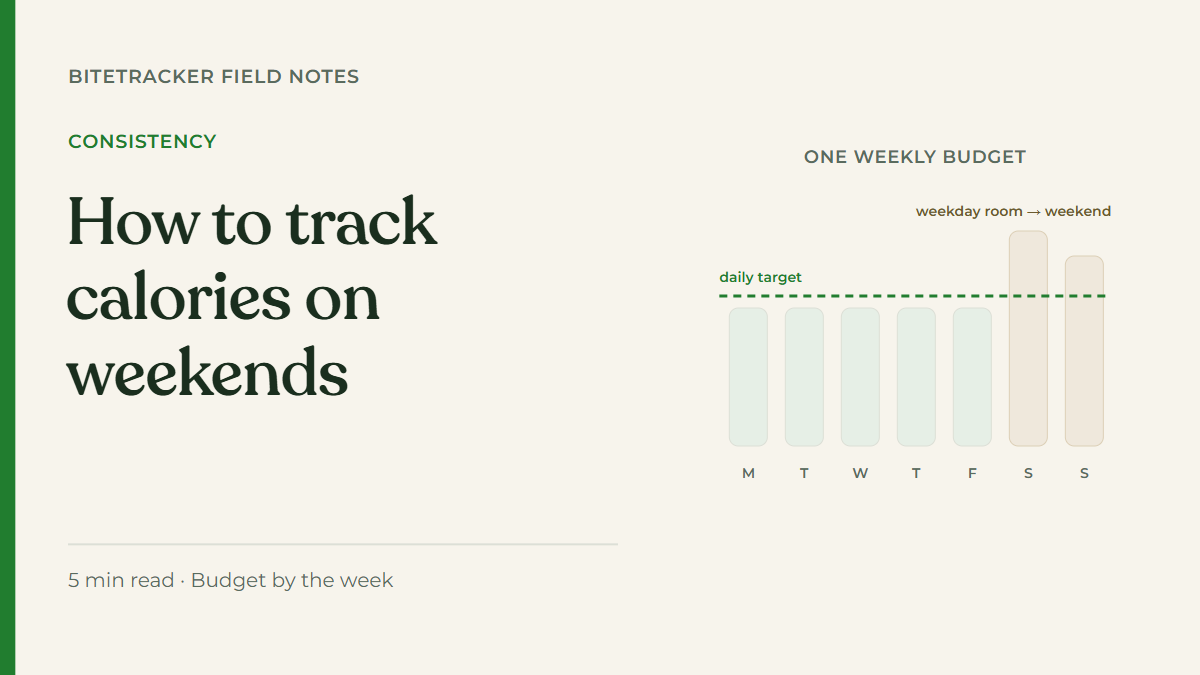
- Think in weekly calories. A 400-calorie daily deficit is 2,800 a week, and one big Saturday plus a relaxed Sunday can use all of it.
- Bank 100 to 200 calories on weekdays if you want more room on the weekend, without dropping below a safe floor.
- Keep logging on weekends, even roughly. Untracked days are where progress quietly disappears.
Plan the weekend on Thursday
The weekend is easier to handle when you have planned for it, not when you try to make up for it on Monday.
Find your weekly number
Multiply your daily target by seven. A 1,900-calorie target is 13,300 calories a week. Looking at the week as one budget makes it clear that a higher-calorie Saturday is fine, as long as the week as a whole still adds up.
Bank a little on weekdays
If your weekends usually run high, eat 100 to 200 calories under target from Monday to Friday. That creates 500 to 1,000 calories of room for the weekend without a deep cut on any single day. Keep protein at target while you do this.
Log the weekend anyway
Log weekend meals the same day, even if the entry is only a rough estimate. A restaurant dinner logged as burger, fries and one beer is useful. A blank Saturday makes the week look better than it was, and you lose the chance to learn from it.
How to handle tracking calories on weekends
The simplest approach to tracking calories on weekends is to budget by the week, not the day. Multiply your daily target by seven, bank 100 to 200 calories on each weekday if your weekends run high, and keep logging on Saturday and Sunday, even with rough estimates. What matters is the weekly average.
This keeps weekends social without letting them cancel out five careful days. It also replaces the all-or-nothing cycle of a perfect Friday, an untracked Saturday and a very low Monday with something you can repeat every week.
Why weekends can erase a weekday deficit
A typical weight loss deficit is modest. At 400 calories a day, a full week of hitting your target creates about 2,800 calories of deficit. A Saturday with brunch, a few drinks and dinner out can easily run 1,800 calories over target. Add a relaxed Sunday 1,000 over, and the week ends at roughly maintenance.
Research shows this pattern is common. In a study of 48 adults, people gained weight on weekend days but not weekdays, driven by eating more on Saturdays and moving less on Sundays. During a year of calorie restriction, participants kept losing on weekdays but stopped losing on weekends.
Where weekend calories come from
It is rarely one meal. It is the extras that come with a looser schedule, and many of them are the same hidden calories in oils, sauces and drinks that slip past on weekdays too.
- Drinks: a 12-ounce regular beer is about 150 calories, a 5-ounce glass of wine about 120, and cocktails with syrups or mixers often 200 or more. Alcohol has about 7 calories per gram, and drinks tend to bring snacks with them.
- Restaurant meals: a study that measured restaurant meals in a lab found they averaged about 1,200 calories, and American, Italian and Chinese meals about 1,500.
- Brunch: pancakes, pastries, bacon and a sweet coffee can pass 1,000 calories before noon.
- Grazing: more time at home often means more small snacks between meals.
- Later nights: a late dinner is often followed by a late snack.
How to budget calories by the week
Start from a daily target you trust; if you do not have one yet, work it out with how many calories to eat to lose weight. Here is a worked example with a 1,900-calorie target. The weekly budget is 13,300 calories. If you eat 1,750 on each weekday, that is 8,750 for Monday to Friday, which leaves 4,550 for the weekend, or about 2,275 a day. That is 375 extra calories on Saturday and Sunday: enough for a couple of drinks or a dessert, with the week still on target.
A few rules keep the bank healthy:
- Keep banking small: 100 to 200 calories a day. Bigger weekday cuts tend to cause hungry evenings and bigger weekends.
- Do not bank below the floor. If your target is already close to about 1,200 (women) or 1,500 (men), add weekday walks instead.
- Keep protein at target on weekdays and take the trim from snacks, fats or drinks.
- Do not compensate with a very low Monday. It usually leads to a hungry week and a bigger weekend next time.
How to make tracking calories on weekends faster
Weekend logging fails when it feels like work. The fix is to accept rough entries and log as you go, not to aim for precision at a restaurant table.
- Log drinks when you order them, not at the end of the night.
- Snap a photo of the plate or describe the meal in one sentence, then adjust the portion if it looks off.
- Copy Saturday breakfast from a weekday if you ate the same thing.
- For dinners out, pick the closest menu item and add a portion of oil or sauce. See how to track calories when eating out for quick estimates.
- Keep breakfast and lunch light and protein-rich on a big dinner day. The breakfast recipe collection lists calories and protein per serving.
Should you take weekends off from tracking?
You can, but only if you account for it. A study that followed daily weights in 80 adults found that weight typically rose on weekends and fell on weekdays. The people who lost or maintained weight were the ones who compensated most during the week.
If full tracking on weekends feels like too much, try loose logging instead: main meals and drinks only, no weighing. If a weekend slips by untracked, estimate it on Monday rather than leaving it blank, using the steps in what to do when you forget to log a meal.
Judge the week, not Monday's weigh-in
The same research found weight tends to be highest on Sunday and Monday and to fall again by midweek. A heavy Monday after a salty dinner out is mostly water, as explained in why the scale goes up in a calorie deficit. Compare weekly averages instead.
In BiteTracker, the weekly report shows your average calories and macros across all seven days. Log the weekend like any other days and the average tells you whether your approach is working, and if not, exactly which days to adjust.
Frequently asked questions
Is it OK to eat more on weekends when counting calories?
Yes, as long as your weekly total still fits your plan. Eating 100 to 200 fewer calories on weekdays creates 500 to 1,000 calories of extra room for Saturday and Sunday. What matters for weight loss is your average intake across the week, not whether every single day hits the same number.
Do alcohol calories count toward my daily total?
Yes. Alcohol provides about 7 calories per gram, and mixers, syrups and juice add more. A regular 12-ounce beer is about 150 calories and a 5-ounce glass of wine about 120. Log each drink when you order it, because drinks are one of the easiest things to forget by the end of the night.
What should I do if I did not log anything all weekend?
Estimate the main meals and drinks from memory on Monday rather than leaving the days blank. A rough total is far more useful than nothing, because it keeps your weekly average honest. Then go back to your normal target, without cutting Monday hard to make up for it.
Is a cheat day bad for weight loss?
A planned higher-calorie day is fine if it fits your weekly budget. The problem with an unlimited cheat day is that it can easily reach 2,000 or more calories over target, enough to cancel most of a week's deficit. A defined extra allowance, such as 400 to 800 calories, keeps the treat without the setback.
Track the weekly average in BiteTracker
Log weekend meals with a photo or a quick sentence, and the weekly report shows your average calories and macros across all seven days.
Sources
- Influence of weekend lifestyle patterns on body weight, Racette SB et al., Obesity, 2008
- Weight Rhythms: Weight Increases during Weekends and Decreases during Weekdays, Orsama AL et al., Obesity Facts, 2014
- Rethinking Drinking, National Institute on Alcohol Abuse and Alcoholism (NIH)
- Energy Contents of Frequently Ordered Restaurant Meals…: A Multisite Randomized Study, Urban LE et al., Journal of the Academy of Nutrition and Dietetics, 2016
This article is general information, not medical advice. If you have a health condition, talk to your doctor or a registered dietitian before changing how you eat.